Field notes · Control basics
Why fleas appear in a DFW home with no pets
Fleas can emerge in a pet-free home after vacancy or come from an unnoticed animal host. Learn how to confirm the insect, investigate room patterns and choose safe follow-up.
Updated October 5, 2026 · 5 min read

The short version
- A home without pets can still contain fleas left by earlier animal occupants or supported by hidden animal hosts.
- Walking or vacuuming can stimulate adults to emerge from protected cocoons in a previously quiet room.
- Confirm the insect and map recurring activity before choosing a treatment.
- Vacuum ordinary flea habitat, but never vacuum suspected rodent droppings or nesting material.
- Find the source and follow product labels; another sighting is not a reason to spray again immediately.
Fleas can appear in a home with no pets because earlier animal occupants left developing fleas behind, or because an unnoticed animal host is still using part of the property. In a vacant home, adult fleas waiting inside cocoons can emerge when people return. The useful first step is to confirm the insect and investigate its source, not assume that a pet-free household needs a whole-house spray.
For a DFW renter or homeowner, this can be a move-in problem, a reopened spare-room problem or recurring activity near an animal entry point. None of those patterns proves the cause by itself. Texas A&M AgriLife's flea guide explicitly describes both long-vacant homes and flea infestations in buildings without pets.
Why can an empty room suddenly have fleas?
Fleas develop through eggs, larvae, pupae and adults. Eggs fall from an infested animal into its surroundings. Larvae develop in protected places, then form cocoons. A fully formed adult can remain inside its cocoon rather than emerge immediately.
Texas A&M explains that a passing animal can stimulate emergence in a long-vacant home or apartment. UC Integrated Pest Management also describes walking on or vacuuming carpet as an emergence trigger. A room that seemed quiet before occupancy can therefore produce adult fleas after normal activity resumes.
That does not mean walking created the infestation. It may have exposed an existing life stage. Nor does one flea tell you when the problem began. Ask about prior animal occupancy and treatment history, but do not use a sighting as proof that a particular resident caused it.
How do you confirm that the insects are fleas?
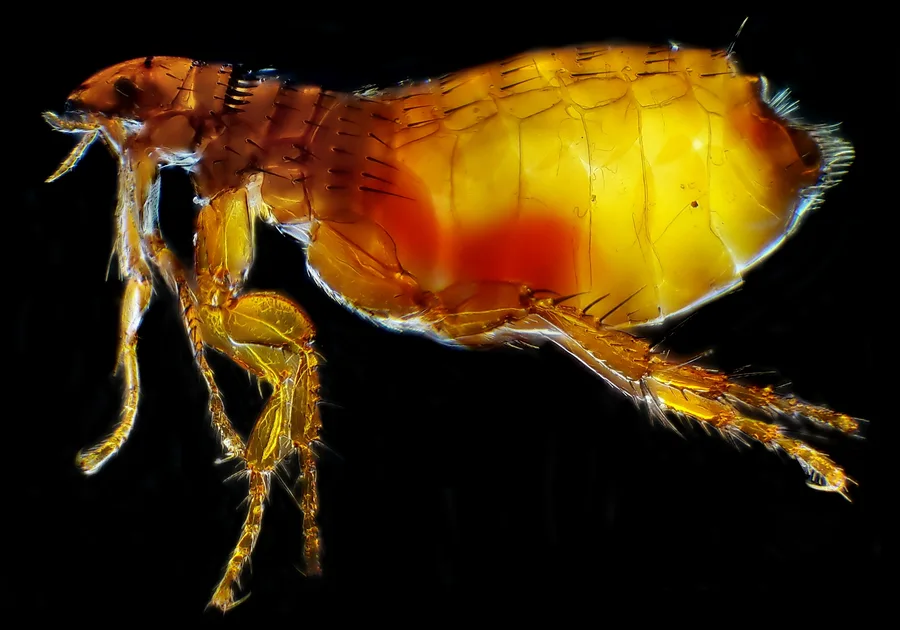
Look for the actual insect rather than diagnosing itchy marks. Texas A&M describes adult cat fleas as small, wingless, brownish-black insects with a flattened body and legs adapted for jumping. Our flea profile has links to identification guidance. A magnified representative photograph helps explain the shape, but it cannot identify every insect in a home.
If possible, save a specimen in a closed container without handling it with bare fingers. Record the room and date, and seek identification from county Extension or a qualified pest professional when uncertain. A blurry image, a jumping speck or a skin reaction alone is not enough to choose a pesticide.
Confirmed fleas can bite people, but Texas A&M notes that cat fleas do not live and reproduce on humans. Do not apply a pet or household flea product to a person.
What sources should a pet-free household investigate?
Start with a short history and an accessible room-by-room check. These questions help organize an investigation; they do not establish which source is present.
- Was the home or room vacant? Note when people returned and where activity first appeared. Ask whether animals previously rested in those rooms.
- Did a used rug or upholstered item arrive? UC IPM recommends cleaning incoming used carpets and furniture because they can introduce fleas. Check the item and nearby floor without carrying suspect belongings through other rooms.
- Is activity concentrated near a sheltered animal area? Texas A&M lists roof rats, squirrels, bats and other animals nesting in structures as possible flea sources even without pets. Note accessible signs near a porch, shed or building opening from a safe distance.
- Does the same location keep producing fleas? Record repeated findings instead of treating each room as a separate mystery. A recurring pattern can help a professional decide where to inspect.
Do not enter an attic or crawl space, disturb a nest or handle a wild animal to complete this check. Suspected animal occupancy needs a qualified assessment. Arrange safe removal and exclusion rather than sealing an occupied opening or improvising poison or relocation.
In a rental, send the owner or property manager dated observations and ask for a source assessment. Our move-in checklist explains how to document concerns without treating a checklist as pest clearance.
What can you clean safely while the source is assessed?
For ordinary flea habitat, vacuum carpets, rugs, accessible upholstery and floor edges regularly. Include beneath reachable furniture and between removable cushions. UC IPM recommends daily or every-other-day vacuuming during an active problem. Follow the vacuum manufacturer's handling instructions and seal discarded bag contents so fleas cannot escape. Wash washable affected bedding or rugs as their care instructions allow.
Do not stop vacuuming simply because a newly emerged flea appears afterward. Vacuuming removes developing stages and can stimulate adults to leave cocoons; that is part of why continued cleanup matters. It is not proof that cleaning made the problem worse.
There is an important exception. Do not vacuum or sweep suspected rodent urine, droppings or nesting material. CDC's rodent cleanup guidance explains that this can put contaminated material into the air. Keep people away and follow the separate cleanup guidance; heavy contamination needs professional assessment. Ordinary flea vacuuming is not permission to vacuum an animal nest.
When is a flea treatment appropriate?
Treatment should follow confirmed identification and a source investigation. If a hidden host remains or an affected resting area is missed, spraying visible fleas alone may not resolve the problem. EPA advises asking a hired pest professional to find and correct the source before applying pesticides.
Some premise products contain insect growth regulators such as methoprene or pyriproxyfen. UC IPM describes their role against immature fleas. They are not a promise of immediate disappearance, and protected cocoons can survive an initial treatment. Those ingredient references are background information, not directions to mix products or treat every carpet.
Use only a product labeled for the identified pest and intended site. Follow its application, repeat-treatment and re-entry instructions, including protections for children and visiting pets. Never use an outdoor-only product indoors or apply a pet formulation to furnishings by guesswork. Read our pesticide label guide before use. If animals visit or return to the home, coordinate any pet treatment with their veterinarian; do not borrow another animal's medication.
How should you judge follow-up and know when to get help?
Keep a simple dated log of confirmed fleas, locations, cleaning and any professional treatment. Compare the same accessible areas over time. Newly emerging adults do not automatically prove treatment failure, but continuing or increasing activity deserves another source assessment. Do not use one sighting to justify an immediate extra spray.
Ask a licensed pest professional about persistent activity, inaccessible suspected hosts or a heavily affected room. Request an explanation of what was identified, what source was found and how follow-up will be evaluated. For routine pet-owning prevention, use the separate DFW flea and tick guide.
Seek medical advice for illness after possible flea exposure. CDC lists fever, chills, headache and rash among flea-borne typhus symptoms. Mention the exposure to the clinician; fleas or itchy marks alone do not establish that disease. This article makes no claim of a current DFW outbreak.
This field guide is educational and does not offer treatment bookings.
Common questions
Can a home without pets have fleas?
Yes. Texas A&M AgriLife describes fleas left in long-vacant homes and infestations supported by animals nesting in structures. Confirm the insect and investigate the source rather than assuming a current pet must be present.
Why did fleas appear when we started using an empty room?
Texas A&M and UC IPM explain that fully formed adults can wait inside cocoons. Walking or vacuuming can stimulate emergence. This may reveal an existing problem, but it does not prove its age or source.
Should I stop vacuuming if fleas emerge afterward?
For ordinary flea habitat, no. UC IPM recommends continued vacuuming because it removes developing stages and stimulates emergence. The CDC exception is suspected rodent urine, droppings or nesting material, which must not be swept or vacuumed.
Does another flea after treatment mean I should spray again?
Not by itself. UC IPM explains that protected cocoons can survive treatment. Follow the exact product label and the professional follow-up plan, and request another source assessment if activity persists or increases.
Sources
Suspects in this article
More field notes
- PreventionCut shade and debris in the yard, vacuum and wash pet bedding, check pets for ticks daily, and ask your vet about on-animal products.
- PreventionCheck visible pest signs before move-in, screen incoming belongings, and monitor the first weeks without treating a checklist as professional pest clearance.
- SafetySignal words, EPA registration numbers, directions, gear, storage and first aid: how to read a pesticide label and protect kids and pets.
- Control basicsTexas A&M's Two-Step Method pairs yard-wide fire ant baiting with targeted mound treatments. Here is how and when it works.