Field notes · Safety
How to read a pesticide label (and keep kids and pets safe)
Signal words, EPA registration numbers, directions, gear, storage and first aid: how to read a pesticide label and protect kids and pets.
Updated October 3, 2026 · 6 min read
The short version
- Federal law makes it illegal to use a pesticide in any way inconsistent with its label.
- The signal words Caution, Warning and Danger describe a product's acute toxicity, from slight to high.
- An EPA registration number on the front panel identifies the product and lets you look up its label online.
- Keep children and pets out of treated areas until the product is dry and the space is ventilated, unless the label says otherwise.
- Store pesticides locked up in their original labeled containers, never in food or drink bottles.
- For a pesticide exposure, call Poison Control at 1-800-222-1222, or 911 if the person is unconscious, struggling to breathe or convulsing.
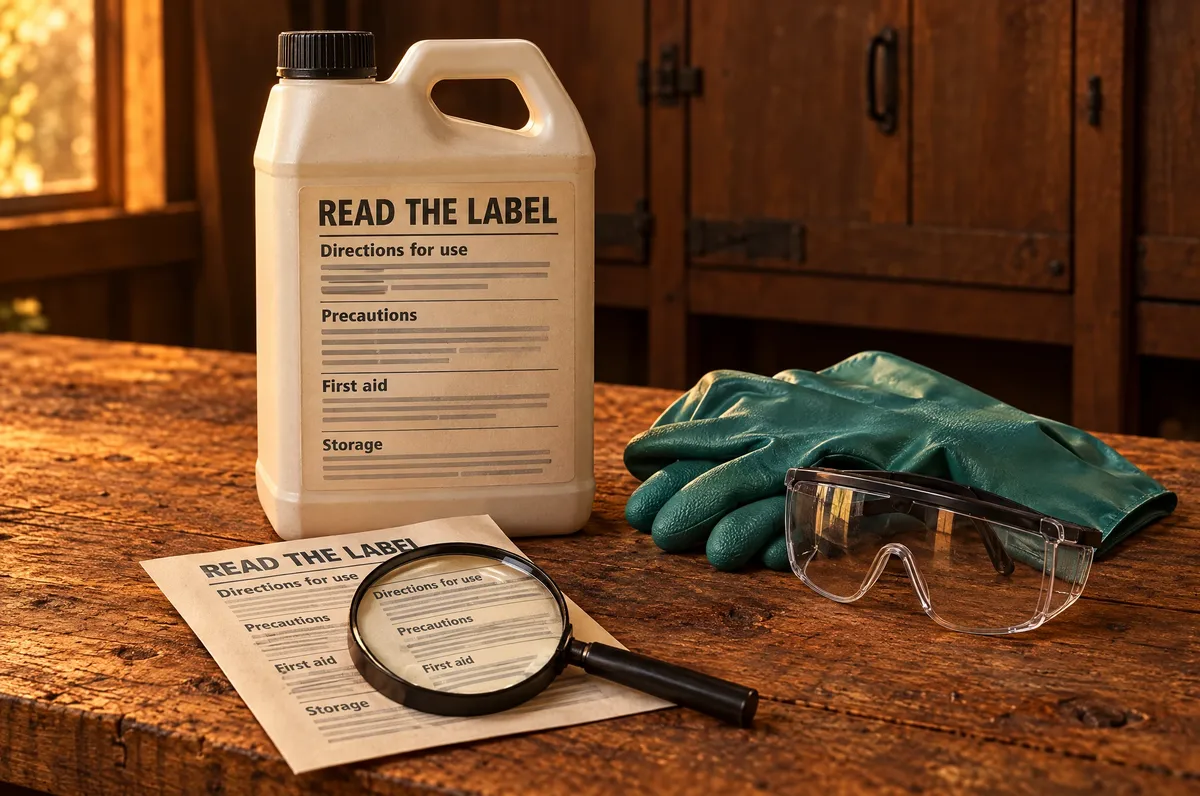
Read the whole pesticide label before you buy and again before every use, because the label is the law: using a product in any way the label does not allow is illegal. Check the signal word for acute toxicity, find the EPA registration number, follow the directions and protective-gear rules exactly, and keep the product locked up in its original container, away from kids and pets. If someone is exposed, have the label in hand and call Poison Control at 1-800-222-1222.
Why does the label matter so much?
Every registered pesticide label carries the line "It is a violation of Federal law to use this product in a manner inconsistent with its labeling," according to the EPA's introduction to pesticide labels. The EPA reviews scientific data before registering a product, and the label is how that review reaches you: who may use it, where, how much and how often.
The National Pesticide Information Center (NPIC) puts it plainly in its guide to reading pesticide labels: do not use a pesticide in any way other than those listed on the label. It also advises reading the label before you buy and re-reading it before every use rather than trusting memory. Products change, and so do their directions.
Read the brand: what are the parts of a pesticide label?
NPIC lists the sections you will find on most consumer labels. Think of it as reading the brand on a steer before you claim it.
- Ingredients. The active ingredient(s) and their percentage.
- Signal word. One word that tells you the product's acute toxicity.
- Precautionary statements. How to avoid harming yourself, others and animals.
- First aid. What to do right away if someone is exposed.
- Environmental hazards. Limits that protect water, wildlife and pollinators.
- Personal protective equipment (PPE). The gear you must wear.
- Directions for use. Where, how and how much to apply, and for which pests.
- Storage and disposal. How to keep the product and get rid of leftovers and containers.
- Manufacturer contact. A phone number or address for questions.
- EPA registration number. The product's unique federal ID.
What do the signal words Caution, Warning and Danger mean?
The signal word is the quickest gauge of how acutely toxic a product is. According to NPIC's signal words fact sheet:
- CAUTION: slightly toxic if eaten, absorbed through the skin or inhaled, or causes slight eye or skin irritation.
- WARNING: moderately toxic by those routes, or causes moderate eye or skin irritation.
- DANGER: highly toxic by at least one route of exposure. When this applies, the word POISON must also appear in red on the front panel.
Do not read "Caution" as "safe." NPIC notes that every product still has the potential to poison at high doses, and that signal words describe acute (short-term) toxicity. Follow the directions on every product, whatever word is printed on it.
Where is the EPA registration number, and why look for it?
Look on the front panel for "EPA Reg. No." or "EPA Registration No." followed by two numbers joined by a hyphen. The EPA's label review training explains that the first part is the company number and the second is the product number. You may also see an "EPA Est." number; that one identifies the facility where the product was made or labeled, not the product itself.
The EPA's smart pest control guidance advises buying only pesticides that carry an EPA registration number. The number also lets you look the product up. NPIC's label and SDS database page points to the EPA's Pesticide Product Label System and NPIC's own product search, both of which accept a registration number. That helps if a label has worn off or you want to read it before you buy.
How do I follow the directions for use?
The directions for use tell you which pests and sites the product is for, how much to use, how to apply it and how often. A few habits keep you on the right side of the label:
- Match the site. Use a product only where the label says it can go (indoors, outdoors, lawns, cracks and crevices and so on).
- Match the pest. Confirm the pest you are dealing with appears on the label. Identify the pest first; our pest profiles can help.
- Measure, don't guess. NPIC warns that using more than the recommended amount wastes money and can harm people, pets and the environment.
- Mix only what you need. The EPA's disposal guidance recommends mixing only enough for the job to avoid leftovers.
- Re-read before you re-use. Directions can differ between products that look alike.
What protective gear does the label require?
The PPE section lists what the person applying the product must wear. That may be as simple as long sleeves and gloves, or it may include eye protection or a respirator. Wear everything listed. If you can't get the listed gear, don't use the product.
How do I keep kids and pets safe around pesticides?
Most poisonings are preventable with a few rules from the EPA and NPIC:
- Keep them away during and after application. NPIC's guidance on protecting children says to keep kids out of treated areas until they are dry and to let the home ventilate before they return. Its pet guidance says to move pets, toys, chew bones, food bowls and bedding out before you start, and to keep animals away until the product is completely dry and the area has been well ventilated.
- Follow re-entry directions on the label. Some labels give more specific instructions than the general rule. The label wins.
- Use barriers and hand washing. NPIC suggests a blanket or other barrier between recently treated lawns or carpets and a child's skin, and hand washing before eating, especially after outdoor play.
- Cover fish tanks. NPIC recommends covering tanks to keep liquids and vapors out, and turning off aquarium pumps during fogger use.
- Watch rodent baits. NPIC notes pets often dig up buried baits and can be poisoned by eating poisoned prey. Place baits only where pets can't reach them, as the label directs.
- Talk to your vet about on-animal products. Flea and tick products applied to pets are pesticides too. See our flea and tick prevention guide.
How should I store and dispose of pesticides?
Storage. The EPA's storage guidance says to:
- Store pesticides out of reach of children and pets, ideally in a locked cabinet in a well-ventilated utility area or shed.
- Keep them away from food, animal feed and medical supplies.
- Keep every product in its original, labeled container. Never transfer pesticides into soft drink bottles or other containers that someone could mistake for food or drink.
- Close child-resistant packaging tightly. The EPA notes that child-resistant does not mean child-proof.
- Keep flammable liquids outside the living area and away from ignition sources such as a furnace, car, grill or lawn mower.
- Avoid spots where flooding, spills or leaks could reach drains or water.
- Buy only what you need instead of stockpiling.
Disposal. The EPA's disposal guidance says to follow the label's disposal instructions, check whether your community has a household hazardous waste collection program, never reuse empty pesticide containers, and never pour pesticides down a sink, toilet, sewer or street drain. Your city or county solid waste department can tell you what's available locally.
What should I do if someone is exposed?
Act quickly and keep the label with you. The EPA's first aid guidance says:
- Call 911 if the person is unconscious, has trouble breathing or is having convulsions.
- Call Poison Control at 1-800-222-1222 for first aid help, and check the label's first aid section.
- Skin: drench the area with water, remove contaminated clothing and wash skin and hair thoroughly with soap and water.
- Eyes: hold the eyelid open and rinse gently with clean running water for at least 15 minutes.
- Inhaled: get the person to fresh air right away.
- Swallowed: induce vomiting only if emergency personnel or the product label tells you to.
The National Pesticide Information Center (1-800-858-7378) answers general questions about products and their toxicity. In an emergency, call Poison Control or 911 first.
When to get help
If the label is unreadable, the pest is unknown or the job calls for gear or equipment you don't have, stop. In Texas, the Texas Department of Agriculture's Structural Pest Control Service licenses and regulates professionals who apply pesticides in and around structures, so a licensed pest professional is an option. For a whole-house approach that puts prevention first, see Integrated Pest Management at home. For any exposure, call Poison Control at 1-800-222-1222, or 911 in an emergency.
This field guide is educational and does not offer treatment bookings.
Common questions
Does a Caution label mean a pesticide is safe?
No. Caution means the product is slightly toxic in the short term, but NPIC notes any product can poison at a high enough dose. Follow every label direction regardless of the signal word.
What is the difference between EPA Reg. No. and EPA Est. No.?
The registration number identifies the product and the company that registered it. The establishment number identifies the facility where that product was made or labeled.
Can I pour a pesticide into a spray bottle or another container?
The EPA advises keeping pesticides in their original labeled containers and never moving them into drink bottles or similar containers. The label carries the directions and first aid steps you need if something goes wrong.
How long should kids and pets stay off a treated area?
NPIC's general rule is to keep them away until the product is dry and the area has been ventilated. Some labels give more specific re-entry directions, and those take priority.
Can I throw leftover pesticide down the drain?
No. The EPA says never to pour pesticides down sinks, toilets, sewers or street drains. Follow the label's disposal instructions and check for a local household hazardous waste program.
Sources
More field notes
- Control basicsInspect, identify, prevent, monitor, treat and evaluate: a plain-English guide to Integrated Pest Management for DFW homes.
- PreventionCut shade and debris in the yard, vacuum and wash pet bedding, check pets for ticks daily, and ask your vet about on-animal products.
- Control basicsTexas A&M's Two-Step Method pairs yard-wide fire ant baiting with targeted mound treatments. Here is how and when it works.
- SafetyBug bombs are not a reliable first response to German cockroaches. Learn their control limits, fire and exposure risks, and what DFW renters and homeowners can do instead.